- Available 24/7 — 365 Days a Year
- Toronto & All GTA — Southern Ontario
- IICRC Certified · Insurance Approved
- Residential & Commercial Services

CALL NOW
(416) 657-2222

(416) 657-2222
How Accurate Is Professional Asbestos Testing?
Asbestos may be invisible, but the danger is real. Found in thousands of older buildings across the GTA, asbestos fibers can silently harm your health when disturbed—causing serious long-term diseases like asbestosis, mesothelioma, and lung cancer.
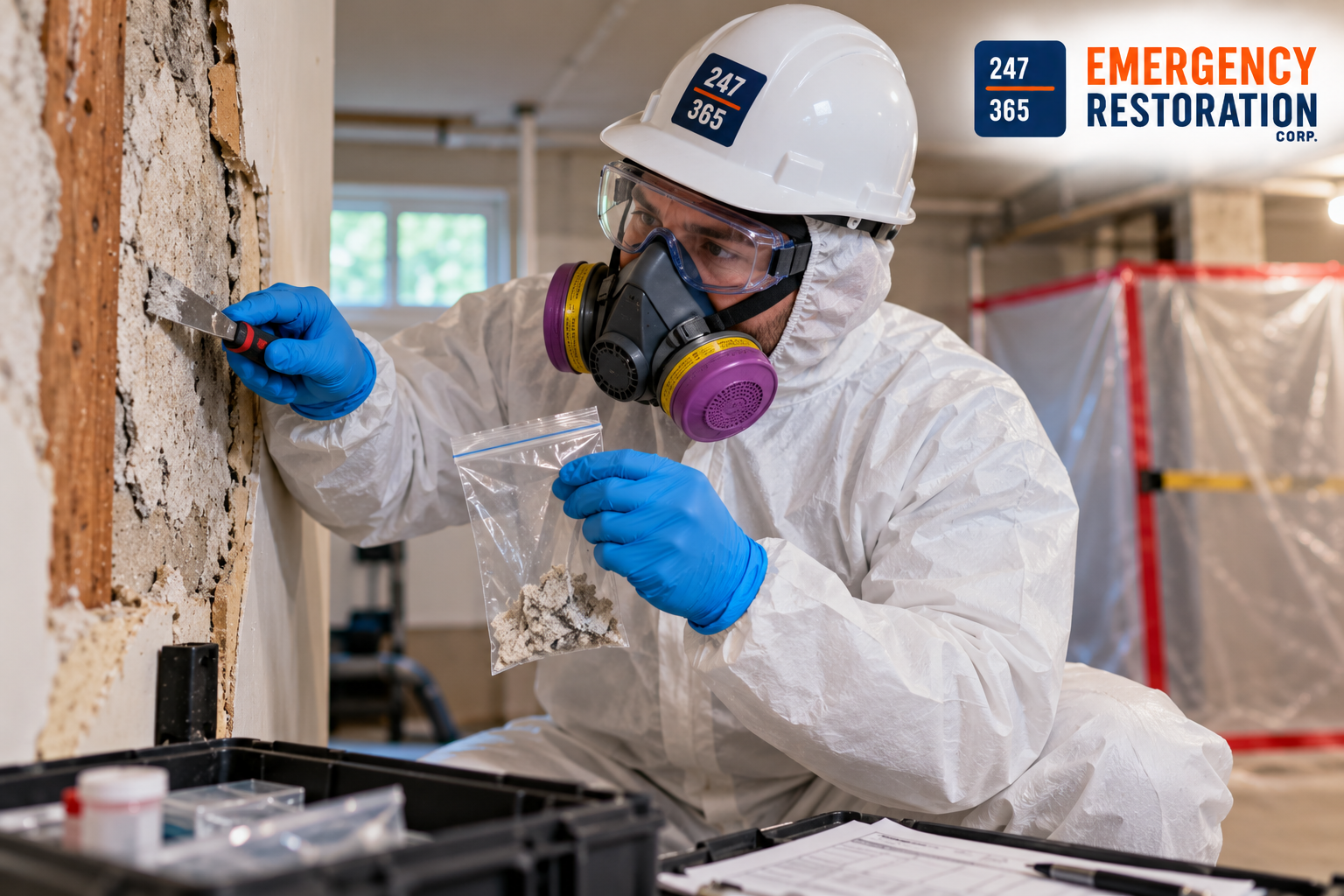
Asbestos is a naturally occurring mineral that was widely used in construction because of its durability, heat resistance, and insulating properties. It may be present in older building materials, including insulation, ceiling tiles, floor tiles, drywall compounds, cement products, and pipe insulation. Although asbestos-containing materials can sometimes remain undisturbed without releasing significant fibres, disturbing them during renovations, repairs, or demolition can create serious health risks.
For homeowners, property managers, and contractors, professional asbestos testing is an important step in identifying potentially hazardous materials before work begins. But how accurate is professional asbestos testing, and can you trust the results?
Professional asbestos testing can provide highly reliable results when samples are collected correctly, representative materials are selected, and appropriate laboratory methods are used. However, accuracy depends on several factors, including sampling quality, material composition, and laboratory analysis. Understanding how the process works can help you make informed decisions about property safety and asbestos management.
Professional asbestos testing is the process of collecting samples of suspected asbestos-containing materials and analyzing them to determine whether asbestos fibres are present.
A qualified asbestos professional typically begins by inspecting the property and identifying materials that may require testing. Depending on the building’s age, condition, renovation history, and intended use, these materials may include:
Pipe and boiler insulation.
Textured ceilings and wall finishes.
Vinyl floor tiles and associated adhesives.
Drywall joint compounds.
Cement siding and other building products.
Insulation around heating systems.
Visual inspection alone cannot reliably confirm whether a material contains asbestos. Materials that look similar may have different compositions, even within the same building.
Laboratory testing provides more dependable information by examining a collected sample using an appropriate analytical technique. The results help property owners determine whether further precautions, professional assessment, or asbestos abatement may be necessary.
Laboratory asbestos analysis can be highly reliable when performed using validated methods by a qualified laboratory. However, no single accuracy figure applies to every asbestos test because different methods, sample types, and collection procedures have different limitations.
One commonly used technique is polarized light microscopy (PLM). It helps analysts identify asbestos fibres in many bulk building-material samples by examining their optical properties.
Another technique, transmission electron microscopy (TEM), provides greater magnification and can help identify very small fibres. It may be used for particular materials or situations where a more detailed analysis is needed.
The appropriate method depends on the material being tested, the purpose of the assessment, and applicable standards or regulatory requirements.
A negative result means asbestos was not identified in the sample using the method and conditions applied. It does not automatically prove that every similar material throughout the building is asbestos-free.
For this reason, reliable testing depends on both laboratory performance and the quality of the sampling process.
Several factors influence the reliability of professional asbestos testing.
The sample must represent the material being investigated. If a sample is taken from an unrepresentative section, the laboratory may not detect asbestos that exists elsewhere in the material.
For example, different layers of flooring, insulation, or wall finishes may have different compositions. A single sample may not adequately represent every layer or section.
Building materials can vary between rooms, construction phases, repairs, and renovations. Even materials that appear identical may contain different ingredients.
A comprehensive inspection helps determine whether multiple samples are needed to assess distinct materials or areas.
Different analytical methods have different capabilities. The material type, fibre size, and composition can affect how easily asbestos is identified.
An appropriate testing method should be selected according to the sample and the purpose of the investigation.
Samples must be properly collected, packaged, labelled, and transported to reduce the risk of contamination, loss, or confusion. Clear documentation also helps ensure that laboratory results are matched to the correct location and material.
Laboratory training, equipment, validated procedures, and quality-control practices contribute to reliable analysis. Using a qualified laboratory with experience in asbestos identification can help improve confidence in the results.
The sampling process is just as important as the laboratory analysis. Even an excellent laboratory cannot provide a reliable assessment of an entire property if the submitted samples are not representative.
Professional asbestos assessors consider the building’s age, construction materials, visible damage, previous renovations, and planned work. They determine which materials should be sampled and whether separate samples are needed from different locations or material layers.
Sampling suspected asbestos-containing materials can release hazardous fibres if performed incorrectly. Therefore, homeowners should not cut, drill, scrape, sand, or break suspected materials simply to obtain a sample.
A qualified professional can select an appropriate sampling approach and follow applicable safety procedures. This is especially important before renovations, demolition, or repairs that could disturb older building materials.
Yes. A false-negative result is possible when asbestos is present in the material or area of concern but is not identified in the submitted sample.
Potential reasons include:
The sample did not represent the material adequately.
Different layers or sections had different compositions.
The sampling plan overlooked asbestos-containing materials elsewhere.
The analytical method was not appropriate for the material or required detection.
The sample was too small or otherwise unsuitable for reliable analysis.
For example, a negative result from one section of flooring does not necessarily establish that all flooring throughout a building is asbestos-free.
To reduce this risk, a professional assessment should consider the variety and distribution of materials throughout the area being evaluated. When results are unexpected or inconsistent with the building’s history, further sampling or a different analytical method may be appropriate.
Asbestos testing is particularly important when suspected materials may be disturbed during maintenance, renovations, or demolition.
Consider arranging an assessment when:
You own or manage an older building with materials that may contain asbestos.
You plan to remove flooring, ceiling finishes, insulation, or drywall.
Damaged insulation or other suspect materials are deteriorating.
Contractors need to cut, drill, sand, or remove existing building components.
Previous renovations have left uncertainty about the materials present.
You need to determine how suspected asbestos-containing materials should be managed.
The age of a building can help inform the assessment, but it cannot confirm whether asbestos is present or absent. Building records and previous laboratory reports may provide useful information, although the materials should still be evaluated in relation to the planned work.
Testing before disturbing suspect materials can help prevent avoidable exposure and unexpected project delays.
A positive asbestos test does not automatically mean that all materials must be removed. The appropriate response depends on the material’s condition, location, likelihood of disturbance, and the planned use of the space.
If the material is intact and unlikely to be disturbed, a qualified professional may recommend leaving it in place and managing it appropriately.
Possible management approaches include:
Leaving the material undisturbed: Appropriate in some situations when the material is in good condition and can be safely managed.
Encapsulation: Applying a suitable coating or treatment to help contain fibres, where the material and circumstances permit.
Enclosure: Isolating the material behind a suitable barrier.
Professional removal: Removing the material when necessary, particularly if planned work will disturb it or its condition creates a risk.
Asbestos abatement should be carried out by appropriately qualified professionals using procedures suitable for the material and applicable regulations.
Do not attempt to remove or repair suspected asbestos-containing materials yourself. If a material is damaged, avoid disturbing the area and seek professional advice.
Selecting a qualified provider can help ensure that the inspection, sampling, and laboratory analysis are appropriate for your property.
Before hiring a service, ask about the assessor’s qualifications, experience, sampling procedures, and the laboratory used for analysis.
You should also clarify:
Which materials and locations will be assessed.
Whether separate samples are recommended.
Which laboratory method will be used.
Whether the laboratory follows recognized quality-control procedures.
How results and limitations will be documented.
Whether the report will include recommendations for managing identified asbestos.
A useful report should identify the materials tested, the sample locations, the analytical findings, and any limitations that affect interpretation. It should also explain whether additional investigation may be necessary.
247-365 Emergency Restoration Corp. can be presented as a contact point for discussing asbestos-related assessment or restoration needs, subject to the company’s actual service offerings and coverage. Confirm whether the company provides asbestos testing directly or coordinates with a qualified testing specialist.
Professional asbestos testing can be highly reliable when appropriate sampling procedures and laboratory methods are used. However, the accuracy of a result depends on more than the laboratory alone. Representative samples, suitable analytical techniques, careful handling, and qualified interpretation all contribute to a dependable assessment.
A negative result should be interpreted in the context of the specific material and locations tested, rather than as proof that an entire property contains no asbestos. When planning renovations or investigating damaged building materials, professional assessment can help identify potential hazards before work begins.
If asbestos is suspected, avoid disturbing the material until it has been properly assessed. Choosing a qualified professional and following the resulting recommendations can help protect occupants, workers, and the property.
Professional asbestos testing can provide highly reliable results when samples are representative and analyzed using an appropriate laboratory method. Accuracy depends on sample quality, material variability, and the analytical technique.
Yes. A sample may not represent other areas or layers where asbestos is present. A suitable sampling plan helps reduce the risk of overlooking asbestos-containing materials.
No. Materials that contain asbestos can look similar to materials that do not. Laboratory analysis of an appropriate sample is generally needed to confirm whether asbestos is present.
Turnaround times depend on the laboratory, analytical method, sample type, and service level. Ask the provider when results are expected and whether expedited analysis is available.
If the work may disturb materials that could contain asbestos, arrange an appropriate assessment before starting. This is particularly important in older buildings or where material composition is uncertain.
50+ Restoration, Environmental, Inspection & Property Maintenance Services – 24/7 Across Southern Ontario